

You will not be allowed to compare more than 4 products at a time
View compareVEGETALLUMINA ANTID*GEL 50G10%
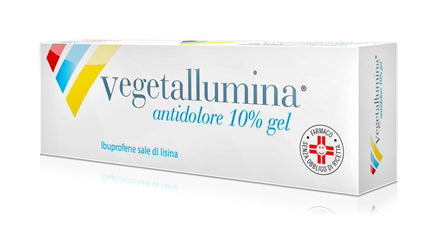
VEGETALLUMINA ANTID*GEL 50G10%
Regular price
€6,20 EUR
Sale price
€6,20 EUR
Regular price
€10,70 EUR
Unit price
per
Tax included.
SKU
041734017In stock
Vendor
PIETRASANTA PHARMA SpADelivery time: 48/72 hours
Free Shipping: Orders over €70
This product page, including its Product Information Leaflet, has been automatically translated.
Description
VEGETALLUMINA Pain Relief 10% gel
Ibuprofen lysine salt
What it is and what it is used for
VEGETALLUMINA Pain Relief contains ibuprofen lysine, which is an analgesic belonging to the class of Non-Steroidal Anti-Inflammatory Drugs for external use.
VEGETALLUMINA Pain Relief is indicated for the local treatment of bruises, sprains, myalgia (muscle pain), muscle strains, and torticollis.
Consult your doctor if you do not notice improvements or if your symptoms worsen.
What you need to know before taking the medicine
Do not use VEGETALLUMINA Pain Relief:
- if you are allergic to ibuprofen lysine or any of the other ingredients of this medicine (listed in section 6);
- if you are allergic to other analgesics (painkillers), antipyretics (fever reducers), non-steroidal anti-inflammatory drugs (NSAIDs) that have previously caused asthma, rhinitis, urticaria or other allergic manifestations in the patient;
- if you are pregnant;
- if you are breastfeeding;
- in children and adolescents under 14 years of age.
Warnings and precautions
Talk to your doctor or pharmacist before using VEGETALLUMINA Pain Relief.
Do not apply VEGETALLUMINA Pain Relief to open wounds or skin lesions.
The use of VEGETALLUMINA Pain Relief, especially if prolonged, can lead to local sensitization phenomena: at the first appearance of a skin rash, mucosal lesions or any other sign of hypersensitivity, discontinue treatment and consult your doctor who may adopt appropriate therapeutic measures.
To avoid more serious hypersensitivity or photosensitization (light sensitivity) phenomena, do not expose yourself to direct sunlight, including solariums, during treatment and for the two subsequent weeks.
In case of more significant allergic reactions (skin reactions, some of which are fatal, such as exfoliative dermatitis, Stevens-Johnson syndrome and toxic epidermal necrolysis), stop therapy immediately and consult your doctor.
Serious skin reactions
Serious skin reactions, including exfoliative dermatitis, erythema multiforme, Stevens-Johnson syndrome, toxic epidermal necrolysis, drug reaction with eosinophilia and systemic symptoms (DRESS), acute generalized exanthematous pustulosis (AGEP), have been reported in association with ibuprofen treatment.
Stop using Vegetallumina Pain Relief and contact your doctor immediately if you notice any of the symptoms related to these serious skin reactions described in section 4.
If acetylsalicylic acid or other non-steroidal anti-inflammatory drugs have caused you asthma, rhinitis, urticaria or other allergic manifestations, consult your doctor before taking the medicine. It is also advisable to consult your doctor if these disorders have occurred in the past.
Consult your doctor in case of concomitant treatment with anticoagulants (see Other medicines and VEGETALLUMINA Pain Relief).
Children and adolescents
The use of the medicine is reserved for patients over 14 years of age only.
Possible side effects
Like all medicines, this medicine can cause side effects, although not everybody gets them.
Side effects can be minimized by using the lowest effective dose for the shortest possible duration of treatment needed to control symptoms.
With some non-steroidal anti-inflammatory drugs derived from propionic acid for local or transdermal (through the skin) use, skin reactions with erythema, itching, irritation, a sensation of heat or burning, and contact dermatitis have been reported.
Photosensitivity reactions (the skin becomes sensitive to light) are possible.
Stop using ibuprofen and contact your doctor immediately if you notice any of the following symptoms:
• Non-raised, target-shaped or circular reddish patches on the trunk, often with central blisters, skin peeling, ulcers of the mouth, throat, nose, genitals and eyes. These severe skin rashes may be preceded by fever and flu-like symptoms [exfoliative dermatitis, erythema multiforme, Stevens-Johnson syndrome, toxic epidermal necrolysis].
• Widespread rash, high body temperature and enlarged lymph nodes (DRESS syndrome).
• Widespread, red and scaly rash, with bumps under the skin and blisters, accompanied by fever. Symptoms usually appear at the beginning of treatment (acute generalized exanthematous pustulosis).
Reporting of side effects
If you get any side effects, including any not listed in this leaflet, talk to your doctor or pharmacist. You can also report side effects directly via the national reporting system at: https://www.aifa.gov.it/content/segnalazionireazioni-avverse.
By reporting side effects, you can help provide more information on the safety of this medicine.