

You will not be allowed to compare more than 4 products at a time
View compareVIVINDUO FEBBRE CONG NAS*10BL
VIVINDUO FEBBRE CONG NAS*10BL
Regular price
€8,18 EUR
Sale price
€8,18 EUR
Regular price
€10,90 EUR
Unit price
per
Tax included.
SKU
044921029In stock
Vendor
A.MENARINI IND.FARM.RIUN.SrlDelivery time: 48/72 hours
Free Shipping: Orders over €70
This product page, including its Product Information Leaflet, has been automatically translated.
Description
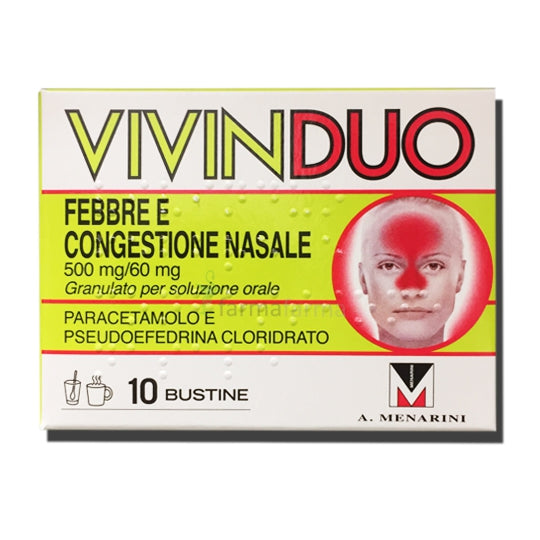
VIVINDUO FEVER AND NASAL CONGESTION 500 mg/60 mg granules for oral solution
Paracetamol and pseudoephedrine hydrochloride
Equivalent medicine
What it is and what it is used for
VIVINDUO FEVER AND NASAL CONGESTION contains paracetamol, an analgesic, which relieves pain and lowers fever, and pseudoephedrine, a decongestant, which acts on the nasal mucosa to clear a blocked nose.
VIVINDUO FEVER AND NASAL CONGESTION is a painkiller, antipyretic, and nasal decongestant, and is used to treat the symptoms of colds and flu.
Consult your doctor if you do not feel better or if you feel worse after the maximum recommended treatment period, if the condition recurs repeatedly, or if you have noticed any recent change in its characteristics.
What you need to know before taking the medicine
Do not take VIVINDUO FEVER AND NASAL CONGESTION:
- if you are allergic to paracetamol, pseudoephedrine hydrochloride, or any of the other ingredients of this medicine (listed in section 6)
- during pregnancy and breastfeeding (see section Pregnancy and breastfeeding)
- for children under 12 years of age
- if you have a deficiency of the enzyme glucose-6-phosphate dehydrogenase (which can lead to the destruction of red blood cells in the blood)
- if you suffer from a severe form of the following diseases:
• coronary artery disease [chest pain (angina), previous heart attack];
• severe hypertension (if you have very high blood pressure) or hypertension not controlled by medication;
• arrhythmias (heart rhythm or heart rate disorder);
• liver failure (impaired liver function);
• kidney failure (impaired kidney function) or if you suffer from severe acute (sudden) or chronic (long-term) kidney disease;
• asthma;
• diabetes;
• urinary problems caused by an enlarged prostate (prostatic hypertrophy) or other diseases;
• haemolytic anaemia (reduction in the number of red blood cells due to their destruction);
- hyperthyroidism (overactive thyroid);
- glaucoma and closed-angle glaucoma (increased pressure inside the eye);
- if you have an adrenal gland tumour known as pheochromocytoma;
- if you are using the following medicines:
• antidepressants belonging to the tricyclic antidepressant class;
• heart or blood pressure medicines belonging to the beta-blocker class;
• sympathomimetic medicines, used to treat low blood pressure or nasal congestion (see section Other medicines and VIVINDUO FEVER AND NASAL CONGESTION);
- if you are using or have used in the last 14 days medicines for the treatment of depression and Parkinson's belonging to the class of monoamine oxidase inhibitors (see section Other medicines and VIVINDUO FEVER AND NASAL CONGESTION).
Warnings and precautions
Talk to your doctor or pharmacist before taking VIVINDUO FEVER AND NASAL CONGESTION.
Talk to your doctor before taking VIVINDUO FEVER AND NASAL CONGESTION:
• if you are elderly
• if you have kidney problems
• if you have liver problems, including liver failure and acute hepatitis
• if you have a deficiency of an enzyme known as glucose-6-phosphate dehydrogenase (see section Do not take VIVINDUO FEVER AND NASAL CONGESTION)
• if you have a reduction in the number of red blood cells due to their destruction (haemolytic anaemia)
• if you suffer from a chronic form of malnutrition and dehydration
• if you have heart and/or blood vessel problems such as chest pain (angina), palpitations or other heart rhythm disorders
• if you have diabetes mellitus
• if you have an enlarged prostate (prostatic hypertrophy) which causes urinary problems
• if you have mental problems (psychosis)
• if your thyroid gland is overactive (hyperthyroidism)
• if you have asthma
• if you have a disease characterised by high pressure inside the eye (glaucoma)
• if you have high blood pressure (hypertension)
• if you have an alcohol dependence (alcoholism) (see also section VIVINDUO FEVER AND NASAL CONGESTION and alcohol)
• if you are using any other medicine (see section Other medicines and VIVINDUO FEVER AND NASAL CONGESTION), in particular:
• other medicines that have effects on the liver (talk to your doctor if you are unsure if this applies to you)
• if you are using medicines that reduce blood clotting (anticoagulants) taken by mouth, as your doctor will consider whether to reduce the dose of the medicine.
Talk to your doctor if during treatment with VIVINDUO FEVER AND NASAL CONGESTION:
• pain or nasal congestion worsens or lasts more than 5 days or if symptoms do not improve within 5 days
• fever worsens or lasts more than 3 days
• you have redness or swelling
• new symptoms appear.
Pay particular attention:
• VIVINDUO FEVER AND NASAL CONGESTION contains paracetamol; before using any other medicine, check that it does not contain paracetamol, as the use of high doses of paracetamol could cause serious side effects, such as liver damage.
• do not take VIVINDUO FEVER AND NASAL CONGESTION with other medicines used for the treatment of pain and fever as serious side effects could occur.
• if you need to undergo surgery, inform your doctor that you are taking VIVINDUO FEVER AND NASAL CONGESTION, as treatment with VIVINDUO FEVER AND NASAL CONGESTION should be discontinued several days before the operation.
If you develop a generalised febrile rash associated with pustules, stop taking VIVINDUO FEVER AND NASAL CONGESTION and contact your doctor or seek immediate medical attention.
See section 4.
Sudden abdominal pain or rectal bleeding may occur with VIVINDUO FEVER AND NASAL CONGESTION, due to inflammation of the colon (ischemic colitis). If you experience these gastrointestinal symptoms, stop using VIVINDUO FEVER AND NASAL CONGESTION and contact your doctor or seek immediate medical attention. See section 4.
A reduction in blood flow to the optic nerve may occur with VIVINDUO FEVER AND NASAL CONGESTION. If you experience sudden vision loss, stop taking VIVINDUO FEVER AND NASAL CONGESTION and contact your doctor or a healthcare facility immediately. See section 4.
Cases of reversible posterior encephalopathy syndrome (PRES) and reversible cerebral vasoconstriction syndrome (RCVS) have been reported following the use of medicines containing pseudoephedrine.
PRES and RCVS are rare conditions that can lead to reduced blood supply to the brain. Immediately stop using VIVINDUO FEVER AND NASAL CONGESTION and seek immediate medical attention if you develop symptoms that could be signs of PRES or RCVS (see section 4 Possible side effects for symptoms).
Caution is also recommended in patients with a history of sensitivity to aspirin and/or non-steroidal anti-inflammatory drugs (NSAIDs).
One of the active ingredients of VIVINDUO FEVER AND NASAL CONGESTION, pseudoephedrine, can cause abuse and high doses of pseudoephedrine can be toxic. Continued use can lead to taking more VIVINDUO FEVER AND NASAL CONGESTION than the recommended dose to achieve the desired effect, resulting in an increased risk of overdose. The maximum recommended dose and duration of treatment should not be exceeded (see section 3).
Children
VIVINDUO FEVER AND NASAL CONGESTION is contraindicated in children under 12 years of age.
Possible side effects
Like all medicines, this medicine can cause side effects, although not everybody gets them.
Rare side effects (may affect up to 1 in 1,000 people)
• allergic reactions (hypersensitivity), including swelling of the skin or mucous membranes (angioedema)
• nervousness, insomnia, anxiety, agitation, hallucinations; especially in children
• dizziness
• headache
• tremors
• changes in heart rhythm (tachycardia, palpitations)
• increased blood pressure
• vomiting, nausea, dry mouth
• increased levels of certain liver enzymes, visible through laboratory tests
• skin rash, erythema, urticaria, itching
• difficulty urinating, particularly in patients with an enlarged prostate volume (prostatic hypertrophy)
Very rare side effects (may affect up to 1 in 10,000 people)
• reduction in the number of platelets in the blood (thrombocytopenia)
• reduction in the number of white blood cells (leukopenia, agranulocytosis)
• reduction in the number of all blood cells (pancytopenia)
• severe skin reactions
Side effects with unknown frequency (frequency cannot be estimated from the available data)
• severe conditions affecting cerebral blood vessels known as reversible posterior encephalopathy syndrome (PRES) and reversible cerebral vasoconstriction syndrome (RCVS) Immediately stop treatment with VIVINDUO FEVER AND NASAL CONGESTION and seek urgent medical attention if you develop symptoms that could be signs of reversible posterior encephalopathy syndrome (PRES) and reversible cerebral vasoconstriction syndrome (RCVS).
These include:
- severe headache with sudden onset
- nausea
- vomiting
- confusion
- seizures
- changes in vision
• reduction in the number of neutrophils, a type of white blood cell (neutropenia)
• decrease in red blood cells (haemolytic anaemia in patients with underlying glucose-6-phosphate dehydrogenase deficiency)
• severe and sudden allergic reaction (anaphylactic shock)
• severe skin reaction that can also be fatal (Stevens-Johnson syndrome)
• severe allergic reaction involving the skin and mucous membranes, which can also be fatal (toxic epidermal necrolysis)
• swelling of the vocal cords, preventing air from entering the lungs (laryngeal oedema)
• confusion
• irritability
• movement disorder characterised by a substantial loss of motor coordination (ataxia)
• seizures
• insomnia
• reduction of blood flow to the optic nerve (ischemic optic neuropathy)
• dilation of the pupils (mydriasis)
• a set of coronary symptoms that occur following a hypersensitivity reaction, an allergy or anaphylaxis (Kounis Syndrome)
• partial or total occlusion of a coronary artery (myocardial infarction)
• alteration of the heart rhythm (atrial fibrillation)
• hypertension
• hypotension
• premature heartbeats, i.e. earlier than the correct contraction, originating from the ventricle (ventricular extrasystoles)
• chest pain in the heart area (precordial pain)
• inflammation of the colon due to insufficient blood supply (ischemic colitis)
• bleeding from the stomach and intestines (gastrointestinal haemorrhage)
• reactions from the stomach and intestines (gastrointestinal reactions)
• taste disturbances
• sudden onset of fever and skin redness associated with the appearance of numerous small pustules (possible symptoms of acute generalised exanthematous pustulosis - AGEP) which may occur within the first 2 days of treatment with VIVINDUO FEVER AND NASAL CONGESTION. See section 2
• skin disease similar to the symptoms of scarlet fever (pseudo-scarlatiniform eczema)
• skin reaction that appears after the administration of a drug (fixed drug eruption)
• allergic reaction involving the skin and mucous membranes (erythema multiforme)
• kidney damage (nephrotoxicity)
• altered kidney function (acute renal failure, interstitial nephritis (severe kidney inflammation), hematuria (presence of blood in the urine), anuria (absence or extreme reduction of the amount of urine produced in 24 hours)
• abnormal contraction of the smooth muscles of the bronchi causing their narrowing (bronchospasm)
• lung infection (pneumonia)
Stop using VIVINDUO FEVER AND NASAL CONGESTION if you develop these symptoms and contact your doctor or seek immediate medical attention.
Other side effects that may occur after taking VIVINDUO FEVER AND NASAL CONGESTION
• sweating
• thirst
• muscle weakness
• severe alteration of heart rhythm (ventricular arrhythmia)
• anaemia
• altered liver function, liver inflammation (hepatitis)
Following the instructions in the package leaflet reduces the risk of side effects. These side effects are generally transient.
However, if they occur, it is advisable to consult your doctor or pharmacist.
Reporting of side effects
If you get any side effects, including any not listed in this leaflet, talk to your doctor or pharmacist. You can also report side effects directly via the national reporting system at: https://www.aifa.gov.it/content/segnalazionireazioni-avverse.
By reporting side effects, you can help provide more information on the safety of this medicine.
